
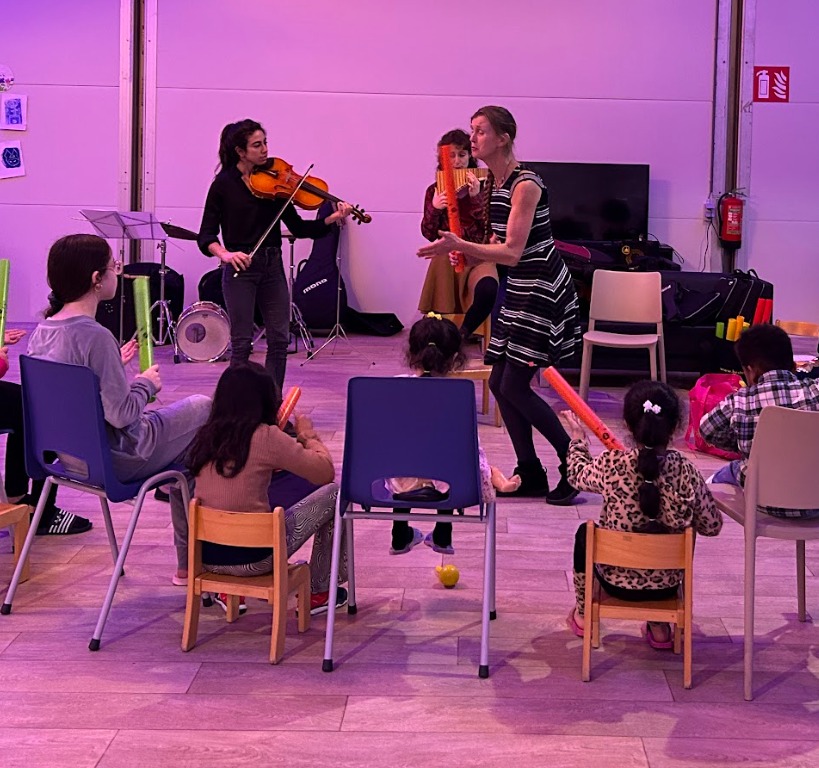
Our Welcome Notes NL program brings our music activities and psychosocial support to refugee and asylum centers around the Netherlands, where refugees from around the world seek safety and shelter for themselves and their families. Oftentimes these centers can be overcrowded, with resources lacking and the stress of the asylum process dictating the daily experience of inhabitants.
In 2023 we started a collaboration with the Conservatorium van Amsterdam (CvA), and provided a series of training sessions with both teachers and students. Thanks to our partnership with the CvA, we are happy to involve music students and teachers in our work by giving them an introduction to our workshop facilitation and an insight into how we run music activities in asylum centers. This month we spoke to Alkistis Μisouli, a Jazz Viola player and CvA alumni who attended one of our sessions.
Alkistis’ background is in classical music, but when she arrived in Amsterdam to continue that path, she found fascination in jazz and improvised music, and the power of improvisation to connect people. Alkistis’ interest in how musical experiences could further bring people together, led her to the creation of concerts in aid of the victims of the Ukraine conflict, and ultimately developing an initiative to bring together music students from the CvA and residents in the asylum centers in the Netherlands.
Miguel Ortega: Was the Musicians Without Borders training something you already knew you wanted to be part of? Or was it something connecting your curiosity and with your own ambitions?
Alkistis Misouli: So I knew a bit about Musicians Without Borders . I had an idea of what the organization does internationally, but didn’t know much in detail. When the war against Ukraine broke out, I got in touch with Katya Dzhanibekyan, a person from Ukraine who was organizing activities for refugees that had just arrived, and then I had the opportunity to organize two concerts with Ukrainian refugees.
When the opportunity to participate in a training with MWB arrived, I was, of course, really excited. I felt like I should be part of this and that it would be a great chance to learn more since I already started something and I wanted to get deeper into it..
M: How do you feel this experience of participating in the training shaped your understanding of this type of work? of using music to create positive change?
A: I remember the workshop day very well. I was very impressed by the ways we could do all these games and use music by not using language at all. So that was the first thing that really made an impression on me. And, I found it very beautiful and not as challenging as I thought. That was still when we were all together with the students and teachers and people who were musically trained – so it was a very idealized version of how smoothly it can go, but it did give me a technical approach to the thinking of a group: thinking of simple things becoming very beautiful, to not neglect simple things. Just because they’re simple musically doesn’t mean that they’re simple as a method or in terms of the effect that they have.
So that was very important. And, what I really like in this sort of format, when there is a leader leading an activity, is that there is also this sweet spot of a leader not being too dominant, or too submissive as well to the situation. It’s important that someone can invite people to participate rather than make them feel that they have to.
During the seminar, but also when we went to asylum locations, I found this very, very important – and something that I guess you also have to learn perhaps. You need to be secure enough in yourself to let people follow you if they want, invite them, and find a way to make it exciting for them, but not command them to do anything, because that creates a very different dynamic. I think it’s an amazing thing that is happening. So that’s one thing I learned regardless of the context. But the context made it even more meaningful: the leadership role, and then also the fact that you can give that role to someone else, like pass it, give everyone importance in being part of what is being done and organized.
M: You mentioned the difference between seeing the activities in the seminar, and seeing them in context in the asylum center. Could you elaborate on that?
A: Of course it was different and there were some challenges. Maybe some people in the center didn’t have the attention or to want to be there for the whole time. It was mostly kids, and then the second time some adults attended as well. There was nothing too rough, no rough behavior and nothing very unexpected happened, but the situation itself was rough because of where we were and how the people at the workshop had arrived in this country. It’s for very tragic, traumatic reasons, But, the people also, I think, were really excited to be part of it.
I wasn’t expecting to see the same kind of atmosphere that we had at the CVA. No one was a trained musician at the center, that’s another layer. But of course, I knew that we’re not going to train musicians, that’s not the point.
M: We spoke about your first interest with improvization, and then you had this experience with doing concerts with Ukrainian refugees. Why then, did you think “Okay. I want to do something with refugees”? What was the main motivation for that?
A: So first of all, these first two concerts for the Ukrainian refugees, I just remember how meaningful they felt.

It was simply a feeling that this was probably the most meaningful concert of my life, because people really needed this concert. It became very clear why we had done it . Before, maybe the “why?” was not clear – for me and for many musicians. And then basically I also thought that I would like to not only give a concert, but to create an exchange.
I realized that an exchange is the most desirable thing. I got into a collaboration with Orchestra Partout at an AZC (Dutch asylum center) in Utrecht, where they do jam sessions. Orchestra Partout has a huge network of musicians, basically from different cities, at AZCs, and also people who don’t even live there anymore. So they’re really doing a lot of this work. To me, the idea of basically bringing conservatory students – and jazz musicians that are my friends that I play with – into contact with a completely different community musically and socially, because I think it sensitizes both communities to each other because probably they don’t know so much about each other.
It’s interesting how isolated they are, but for completely different reasons. When musical communities are separate, then we also tend to see music sometimes isolated in different social circles or establishments like the Conservatory, which is a bubble of its own. So the moment we went there, I saw the reaction of the conservatory students of, wow, this is not a jam session like we’re used to, we have to play and react differently. It’s not because I think that I am the one to give the refugees a relief. It’s because I think that we can both find very exciting things musically first of all.
So it was challenging in different ways for both groups – but also socially, of course, not just musically, but to make different communities meet and learn from each other, not to have a feeling that one is isolated, as they’re both isolated in different ways.
M: Now that you have had several experiences with Ukraine refugees, with Musicians Without Borders , and with your own project in asylum centers in the Netherlands, do you have any meaningful lessons that you would like to share about your experience?
A: Yeah, I do have a meaningful story. Generally, I got more and more convinced after each time we did this, after each different kind of session. It only brought good things. It only taught me more. The musicians I was with, it taught them it sensitized people in a very different way. And, for me, it’s necessary to continue this.
I would really love to get deeper into it and also bring it to Greece, where it’s very much in need, because in Greece there’s almost nothing happening and conditions are even harder than in the Netherlands.
I would love to keep doing this in both places. I will say that the most meaningful thing for me is that when I carried out the project I had Israeli musicians with me and they didn’t have to worry about their identity. They encountered different people from different regions in the Arab world; I was apprehensive, but I was so surprised that every time, actually there was a huge amount of connection through music, but also through respect. I knew who I was bringing and how sensitive the situation could have been, but the fact that, in front of my very own eyes I could see that such conflict doesn’t have to cancel any human from any side. It can actually be a platform for conversation to something much greater than just a music session. Of course it stood out for me so greatly that I could say that there was like a seed of peace, you know, in the way I saw these kinds of interactions happening, not only being driven by trauma or through hate. For me, it was very important.