
A young man stands in front of a concrete wall.
Above it, a blue sky that knows no borders.
He’s in his early twenties. Confronted by the greyness of exclusion, he simply sings a love song.
This wall belongs to the Lipa reception center, in Bosnia and Herzegovina, just kilometers from the European Union border. Practically, it is a wall built to enclose a camp. But it is also symbolic. It mirrors the physical, political, social, and economic walls Europe has built to decide who is welcome, and who is not.
Choosing to sing a love song when living within this reality is a radical act of resistance.
Being a person who is experiencing forced migration is to be constantly defined by what you lack: a home, a passport, and a legal status. The European Wall seeks to strip individuals of their complexity, and reduce them solely to their struggle. The system expects people to resign to their fate in such an environment. It expects the person to be crushed by the weight of the journey.
But by stopping to sing a love song, this young man refused that narrative. He declares that he is still a person who loves, who remembers, and who feels joy. It’s a refusal to concede his humanity and dignity to the concrete walls surrounding him.
During his performance, around 50 people gathered in total silence to listen in a collective moment of humanity. They were resisting the pressure to become nothing. They were reclaiming their right to be.
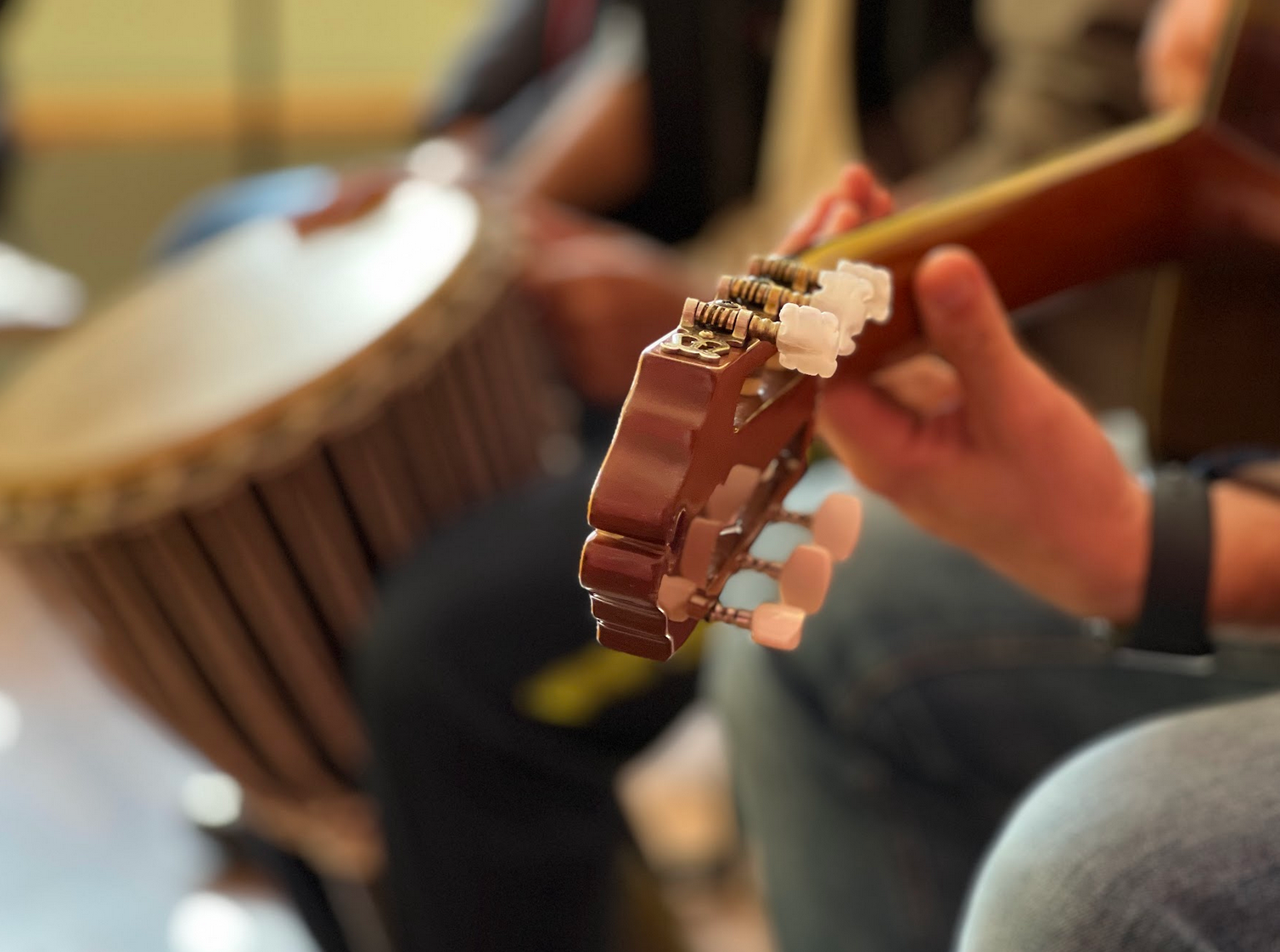
This moment emerged organically during one of our music workshops. Towards the end, instruments were picked up. People strummed guitars and mandolins. Another played a tarabuka softly. Chord patterns were improvised, and a natural rhythm settled. Then one participant began to sing and everyone in the group started singing along; the song belonged to all of them. Nothing needed to be explained. It just flowed. The next day, our team came back to film him singing this song. He said he would remember this moment for the rest of his life, like us.
Our team at Welcome Notes Bosnia and Herzegovina (BiH), supported by our partners Caritas BiH works directly in these environments. We see this work as a shared resistance.
For Mia and Jasmin, our workshop leaders in Bihać, this is the core of their work. They are there to build a bridge through sound.
Mia’s journey began in 2019, when there was a media focus on Bihać because of inhumane conditions at one of the camps near the town. When she remembers seeing arrivals come in from this time, she speaks of the “mix of joy and sadness in the air” and the challenge of bringing a smile to the face of a man who feels the world is his enemy. Jasmin described the privilege of stepping outside “traditional musical frameworks” to experience music in a deeper, more human way.
Our team brings music to these soulless walls not to drown out the reality of the border, but to amplify the humanity of those standing outside of it. We provide the psychosocial support that comes from sharing a rhythm, recording a track, and moments of collective creativity. We don’t give people a voice because they already have one. We simply provide the space where that voice can be heard above the noise of exclusion.