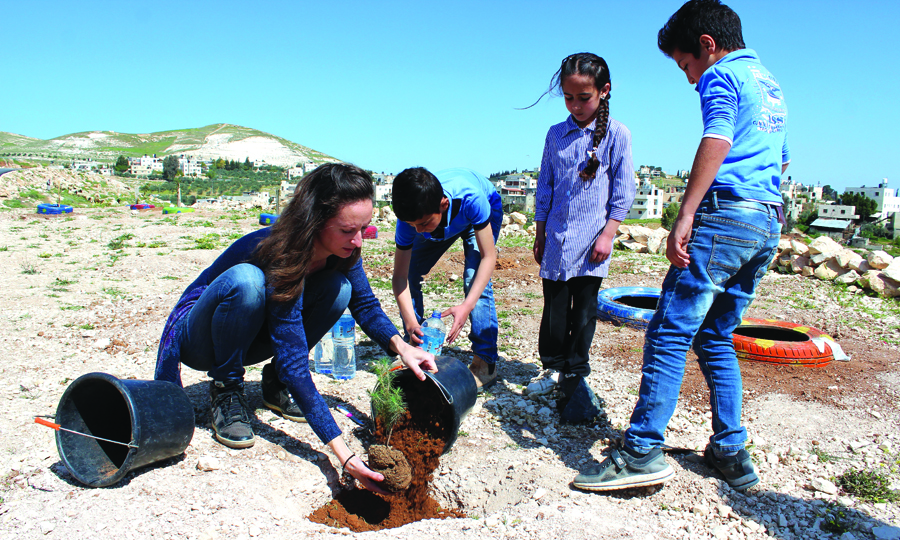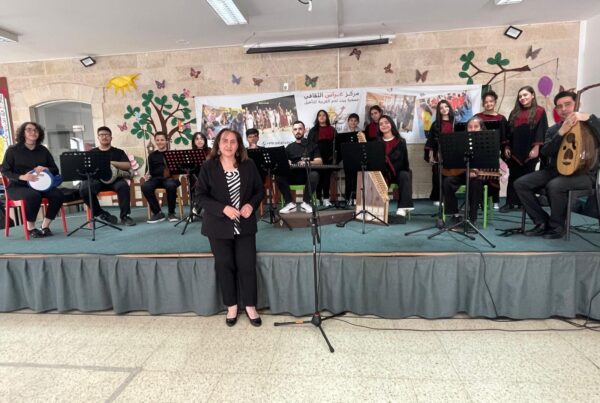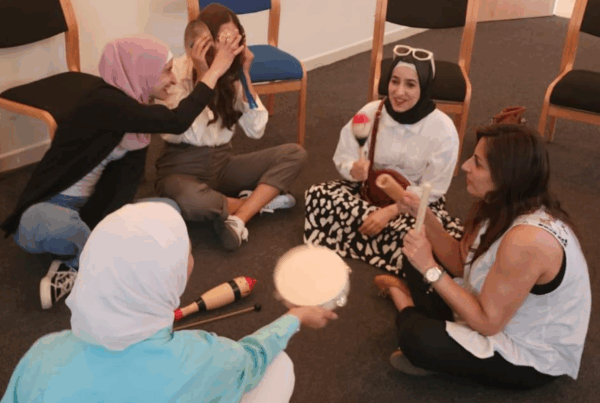
This interview was originally published in the Cypriot newspaper Kathimerini, authored by Apostolos Kouroupakis. It features an interview with Fabienne Van Eck, our Program Manager in the Middle East, who oversees our Al-Musiqa Tajm’ana program in Jordan and the Bara’em Ghirass program in Palestine. This interview was held as part of the CARE Festival in collaboration with Larnaka 2030, a project promoting Larnaka, Cyprus as a candidate for the European Capital of Culture.
On Sunday, November 10, as part of the CARE Festival, the Foundation for Cultural Creation for Children and Youth in collaboration with Larnaka 2030, organized a full-day conference for parents, artists and educators at the Larnaka Municipal Theater “G. Lykourgos”. Speakers included mothers and children from different backgrounds, with the keynote speaker being Fabienne Van Eck, a musician and peace activist and member of the international organization Musicians Without Borders . Ms. Van Eck spoke to “K” about the organization’s work and says that she is lucky to experience the wonders of music every day, stating: “I feel that just being able to play music, or just enjoy, listening to music, is already a miracle.”
Is Music able to do miracles?
To answer this question, I looked up the definition of the word miracle in Oxford Languages and I found the following:
- a surprising and welcome event that is not explicable by natural or scientific laws and is therefore considered to be the work of a divine agency.
- a highly improbable or extraordinary event, development, or accomplishment that brings very welcome consequences.
- an amazing product or achievement, or an outstanding example of something.
I do not think this is the right place to discuss divine miracles, but if we look at the second and third definition then music is definitely able to create miracles. Research has shown that playing and listening to music affects our biological, emotional, and social state. For example, singing can lower your pulse rate, release endorphins, and help you to calm down because your outbreaths are longer than your inbreaths. However, listening to fast, energetic music can increase your pulse rate, give you more energy and can help you to increase your speed or strength during sport activities. Making music together can connect people, increase empathy and self-esteem. Music activities can help to discover and develop one’s creativity. Being creative helps people take ownership of their lives, and to find different solutions when facing a problem. Through music making and song-writing, feelings and emotions can be expressed, even when someone is not able to talk about them. This can help people to process difficult emotions or events that have happened in the past. I am lucky to experience the miracles of music daily.
At the same time, I feel that just being able to play music, or to just enjoy hearing music, is already a miracle. With all the destruction and violence that is going on around us, we need to treasure every moment of beauty. When we performed the theater-music-circus show “Use Your Brain” in Larnaka last week, there were several children from Syria in the audience who came without their parents to Cyprus. After the show, the children told the actor Ahmad Juabeh that it was the first time in their life that they saw a circus and a theater with lights. They did not know a unicycle existed, and in the show, Ahmad rides two different kinds of unicycles. Imagine what an impact this can have on a child. It’s an experience that can stay with them, giving them hope for a better future.
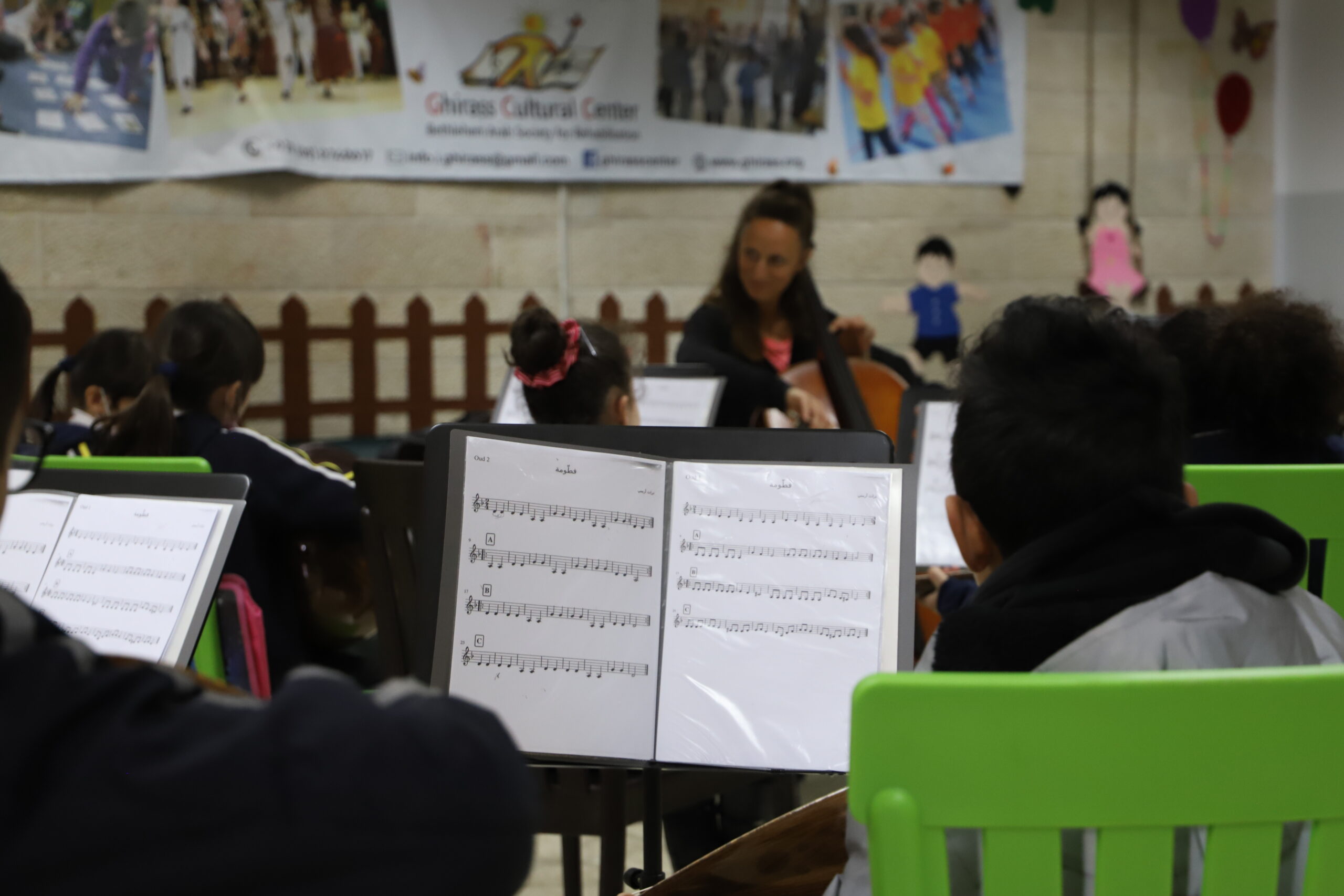
“I had a 65-year-old student who was in serious pain after a bicycle accident. The pain was so severe that she was given the option to have her leg amputated, which she refused, and had a special brace put around the leg instead. One night, she heard some cello music playing on the radio, decided she wanted to learn to play it, and became my student. Before the accident, she was a professional dancer and horseback rider, which she was unable to continue doing, but through learning to play music, she found a new meaning in her life. She started practicing the cello in the mornings, taking a lunch break, going back to play again until the evening. She would use her discount weekly taxi rides to go to concerts, and she recorded all her lessons , as the morphine made her forget things quickly, and this meant she could listen to them every day. Before she passed away, she gave me back the cello I lent her and the bow that she had bought, so I could give the cello and bow to one of my students in Palestine. Since then, several students have used the cello and bow, and I always tell them her story. I have a 10-year old cello student who is on the autistic spectrum and he is suffering a lot from the ongoing war. The cello is his best friend. Some days he tells me: “Miss, I feel so sad, the only thing that can make me feel better is playing the cello.”
Culture is a way to build bridges. But can these bridges be continuously open, when politics and politicians take over?
Bridges can be built and bridges can be destroyed. I think we need to focus on how to build the bridge, not on the bridge itself. When people know how to build a bridge, they can always build a new bridge when one gets destroyed. They can choose to build an alternative bridge in a different place, maybe for a short time, maybe for a longer time, until they can rebuild the original. Culture and music can help to teach people how to build bridges, but also to motivate people to build bridges and to feel the need for these bridges.
Playing and listening to music from other cultures, and playing with musicians from other cultures, can help people to find similarities and common ground. Although our music might sound very different, the reasons we play music might be the same. Accepting and respecting the differences between us and the others, having a strong cultural identity while at the same time being open minded to learn about other cultures and working together, are very important for a healthy community.
Is there a method that you follow for your projects?
All our projects are based on our five working principles, which are Safety, Inclusion, Creativity, Equality and Quality. Ideas for our projects always come from the local communities who invite Musicians Without Borders in. Together, we write a project proposal, we do the fundraising, and when the funding is secured, we start the project. Because we always follow the ideas that come from within the community, we have a very diverse collection of projects, including Rock Schools, Music and Nonviolence Leadership Training, Music as Therapy training, music workshops for deaf children, Children’s Orchestras, music education for children with HIV, music workshops for children in asylum seekers centres, rap workshops, establishment of a recording studio in a refugee camp and music workshops in schools, refugee camps, hospitals and orphanages.
What have you earned/learned from Musicians Without Borders
I have learned to go with the flow. I was born and raised in The Netherlands but have been living for the last 18 years in Palestine. There have been many times when I did not understand something and I thought my way or idea would work better, only to find out that my idea was not going to work and there was a reason for the others to do it differently. I learned to accept other people’s way of working and living, even when I did not understand any of it. It always turned out to work much better than when I tried to push my idea or my way of doing things. I learned to swallow my feedback or advice, and only give some if people ask for it. Many people here have fewer advantages and privileges than I have, and it is easy to offer everyone help. But often that’s not what people need or want. I learned to take a step back, to listen, to observe, and ask if anything is needed from my side. I learned to trust the process and to let go of control, because that is when the most beautiful things happen! When I give my students or team trust and freedom in their work, they take responsibility and ownership, and together we can create without losing energy or feeling frustrated.