
We have had some bad news from our Welcome Notes program in Bosnia and Herzegovina – the safehouse in Tuzla, a vital space where we carried out music sessions and workshops, has sadly had to close. The safehouse functioned as an independent NGO, and was funded by Caritas BiH as well as with the help of both local and international partnerships and collaborations. However, sadly, these avenues of funding have come to an end, and the safehouse has had to close its doors, at least for the time being.
This undoubtedly has an impact on our work in the region – while we are still able to carry out Welcome Notes workshops in other areas of Bosnia and Herzegovina, the people we were supporting in Tuzla currently cannot be supported until we find a new safe place to carry out sessions in.
Our leaders in the region are obviously incredibly saddened by this closure, not just for those housed there, but also for what the safehouse stood for; a place of rest, protection, and visibility for people undergoing traumatic journeys. Many of those that have been housed there over the years have said that they felt seen and heard during their stays.
Contrary to what many people believe too, having a safehouse where migrants live within a local community actually helps build cohesion. It gives both residents and those there temporarily the opportunity to talk with and learn from each other in a mutually beneficial way. And having a physical space for migrants to go increases public safety, as those desperate for accommodation don’t need to go to extremes in order to find security. The coordinated actions of the safehouse took people off of the streets, met their basic needs, and gave them more stability than they otherwise would have had.
Add music to this mix and you create magic. Music has helped the people in the safehouse with opening up and feeling like they are a part of the community in which they’re housed. Giving people the opportunity to embrace music and use it in helping them to open up creates a valuable space, the lack of which will leave a void in the heart of the city.
When the safehouse initially opened up, the local population was wary, but over time, the house grew to be an intrinsic part of the community after both groups of people opened up to one another and shared about their experiences.
The Tuzla safehouse was also instrumental in building and creating models of safe accommodation for those facing forced migration, and offered a space in which to try various approaches out. Models developed in Tuzla have been taken up by other safehouses in Bosnia and Herzegovina, as well as around the wider region.
Our trainers in Tuzla, Almerisa and Fahrudin, said “The closure of the Safe House has left a void — not only in terms of available beds but also in the loss of a trusted space where people could build mutual understanding and a sense of community. The absence of such support means that many are now deprived not only of basic living conditions but also of the emotional and social care that was vital for their mental health and dignity.”
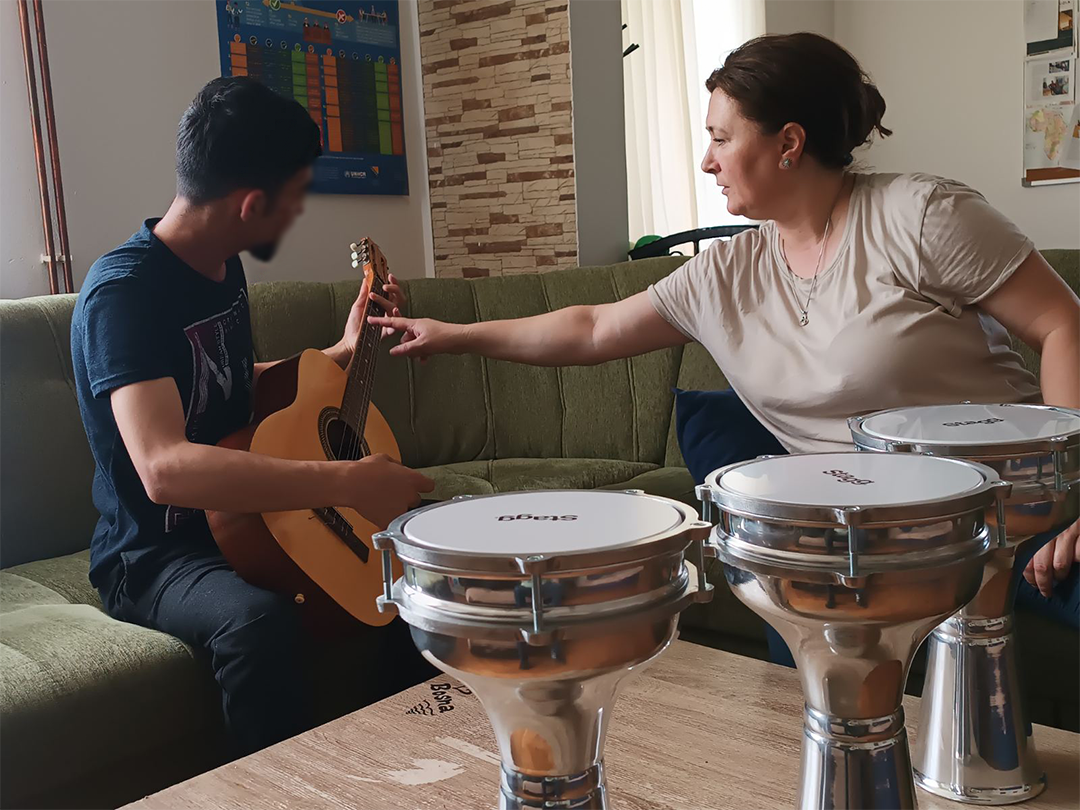
“As the facilitator of music workshops in the Safe House, I had the opportunity to witness people transform. At first, many rejected music — influenced by prejudice, trauma, or cultural traditions. They arrived tired, closed off, often silent. But then something would happen — they would pick up an instrument, hear a familiar melody, create something new, or proudly present their culture and talent through music. And so, hours and hours would pass in music-making, laughter, and snacks shared among strangers who slowly became a community.”
“For me personally, as the person who led those workshops, it was one of the most profound experiences of my life. I learned about empathy, pain, resilience — and just how little it takes to give someone hope. How our ‘little’ can mean so ‘much’ to someone else.”
H and A, two people who attended sessions at the safehouse, shared their experiences of their stay, the music workshops, and the overall impression they carry with them before the house closes.
Upon arrival in Bosnia and Herzegovina, the two were placed in a camp around Sarajevo. The conditions in the camp did not suit them, and they described the situation as difficult and unsafe. “There are many people, problems and dangers in the camp.”
For this reason, they looked for an alternative, and thanks to the people they met there, found out about the Safe House in Tuzla. They met a Bosnian man who explained to them how to get to the house, which was ultimately crucial for their arrival and accommodation. Describing their stay in the Safe House as an extremely positive and important part of their journey: “The safe house is good.” they said. “The employees are good people, not only for medical care, clothing, food… but in every sense.” Emphasizing how much it meant to them to have a place to rest, silence and a sense of security, especially after a very demanding migrant route that lasted six months.
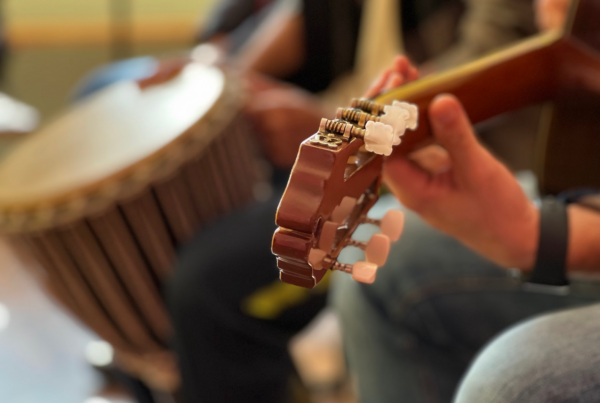
They spoke positively about the music workshops. Although they had no contact with instruments before, these activities were a new and liberating experience for them: “We love music – tarabuke, guitar – but we didn’t have time for that before. We just watched and listened to others play. When I played the tarabuka, I felt free. I played with my heart. When we play, we remember where we came from, the route, everything we went through. We feel good.”
“I thought it was difficult to play music. I never used these ‘machine’ instruments, but now, when I tried, I realized that I can. And now I love the guitar, I love music.”
Staying at home was not only a physical refuge for them, but also a space for expression and interpersonal connection. They emphasized how much it meant to them that they could participate in different activities with people from other countries who came to the house and communicated with them: “I felt like a man. Those people looked at me with respect, and as nothing else but a man. The whole time I was here I felt accepted and respected.”
The closing of the house represents a great loss for them, not only personally but also for all future people who will be denied such a space: “This should not be closed. Many people on the move need a place like this, these people, these workshops. These activities are good and necessary.”
At the end of our conversation, they expressed their desire to send a message:
“I am a migrant. On this trip I met many people, had support. But I want to say with all my heart that respect and love should prevail among us – to feel humanity. We are grateful to everyone in the house. I have never used these instruments before. Now I love the guitar, I love instruments, I love music, Thank you teacher “.
We will remember the Tuzla safehouse as a symbol of humanity, solidarity, and hope.
We are committed to resuming our work in Tuzla as soon as possible. Together with our partners Caritas BiH, we will work to find a new safe space for people undergoing forced migration, or help secure the reopening of this safehouse, so that the music, connection, and community it cultivates can continue.