
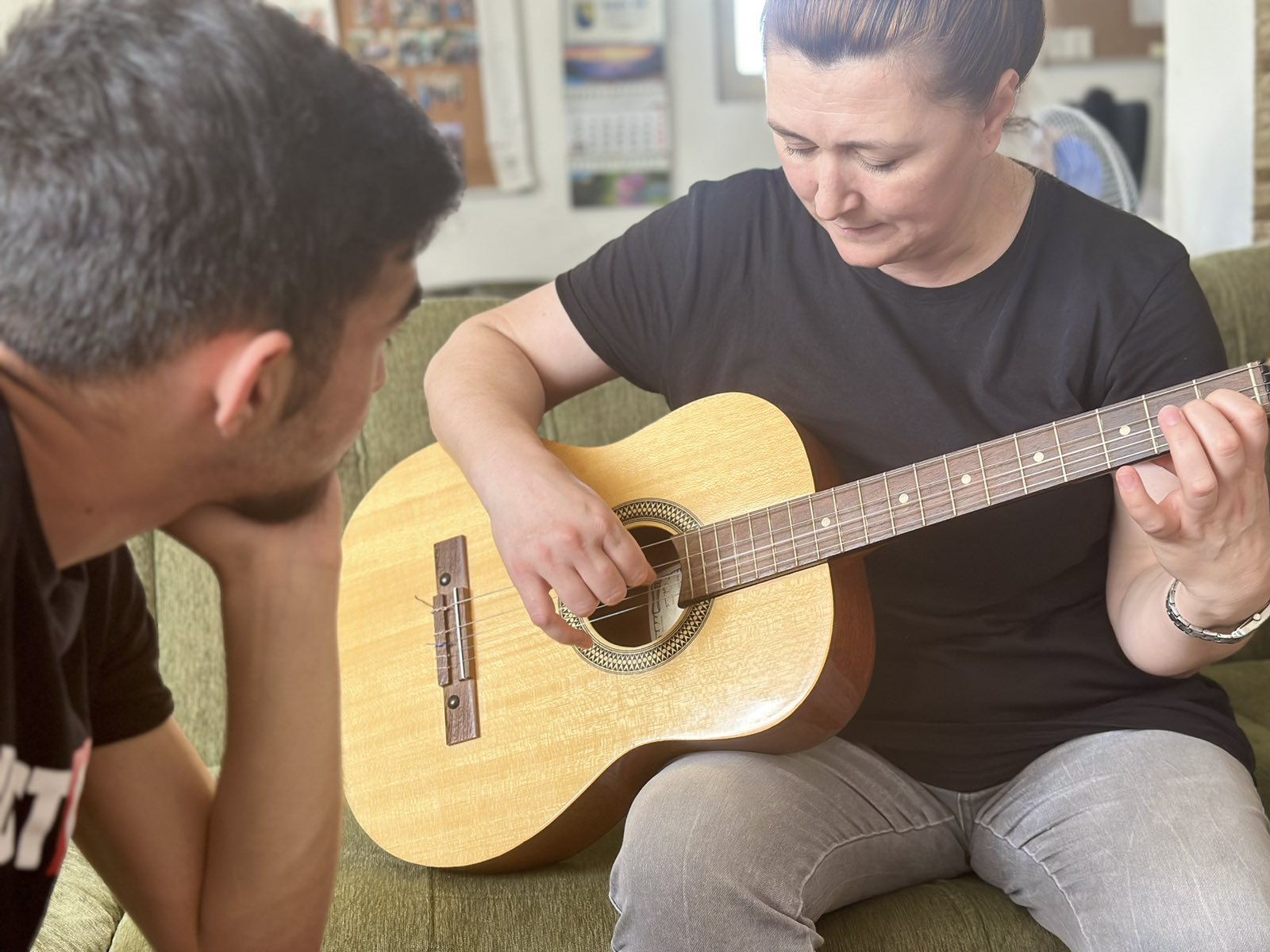
My name is Almerisa, and I am a Musicians Without Borders workshop leader and trainer in Bosnia and Herzegovina. We use music to support people in reception centers and safe houses, who are fleeing war and persecution.
Today I want to tell you the story of one man who wanted to get from Syria to Germany, to find safety and build a secure future for his four daughters. In his eyes, there was no room for anything but work and progress towards his family’s future. He believed that every minute spent on an activity that was not directly related to moving forwards towards his family’s goals was a waste of time.
Upon hearing about the music workshops, he said to me directly: “Music? What do I need that for? I have to work. My family needs food, they are not safe, and I have to get to Germany as soon as possible to earn money for them.”
His entire focus was on survival, and music seemed unnecessary — almost a luxury he couldn’t afford. However, even though he was firm in his stance, he began occasionally observing the workshops, sitting on the side. He watched as other participants played instruments, mostly drums, and how they sang and connected through the rhythms. At first, he seemed disinterested, sometimes even skeptical about how this could help him in his struggle for survival.
But something in the rhythm of the drums, in the energy that filled the space, started to move him.
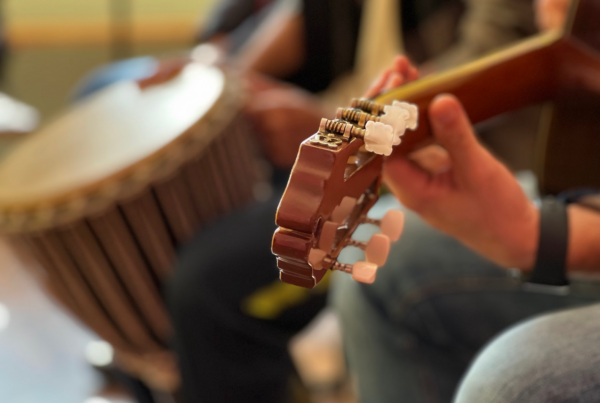
At the next workshop, he suddenly approached the group, picked up one of the drums, and slowly began following the rhythms. There were no big performances or professional shows—he simply followed the basic beats and tapped on the drum. That moment was crucial because he chose to engage on his own, despite initially not even wanting to be in the same room.
As he played the rhythms, his connection with the group grew stronger, more intense, and soon he started singing — quietly, but with deep emotion — lyrics that reminded him of his homeland and his family. He sang short songs about his daughter, about his hope that he would soon see them again, about how his heart was filled with love for them, and about his desire for success.
It was a moment of release — one of the rare moments when he could express his deep feelings about his family and his situation through art.
Music began to have a different meaning for him. It was no longer a luxurious waste of time, but a tool for expressing emotions he couldn’t share with others. His view of the workshops and music completely changed – he started to understand that music, although seemingly unnecessary at first, could be a way to relieve stress, and to connect with his feelings and with other people. Instead of taking time away from him, it allowed him to process his emotions and find strength for the next steps on his journey.
Although his primary goal was still to find work and send money to his family, he now had another way to cope with difficult emotions and refresh himself for the next step on his path. That was the moment when he realized that, although he had to fight for his family, music could be a way for him to gain strength, release pain, and move forward with even greater enthusiasm.
His is just one of hundreds of stories that come out of the Welcome Notes program in Bosnia and Herzegovina every year, and is a strong example of why the work we do is vitally important. Music can open up parts of ourselves that are normally inaccessible, and can help us to express emotions that normally seem too heavy.
With your support, we can continue our vital work in Bosnia and Herzegovina. €15 covers our transport costs to and from the sessions, €50 helps us bring food and drink to the participants, and €60 helps us to buy new instruments, strings, and other materials to keep the workshops running. Please donate whatever you are able to today to our This Is Me campaign, and help more people build resilience and express their emotions through music.