
This blog was written by Laura Hassler, Director Musicians Without Borders
What times we live in. Genocide in Gaza, facilitated by the world’s great powers while claiming to ‘defend democracy’ as they repress dissent. A constantly escalating proxy-war in Ukraine, threatening global nuclear annihilation. Millions displaced in Sudan. And Congo, the world’s richest land, being destroyed by armed militias and the regional and global powers behind them, competing for ownership of its resources. Only naming the most visible here….
It has of course always been so, but 25 years ago, when Musicians Without Borders began, our gaze was narrower. For a group of musician friends in Europe, the wars in the nearby western Balkans were, perhaps, all we could manage to see—luckily, otherwise we could never have started.
In 1999, no one had ever heard of the idea—applying the power of music where war had raged, to connect and re-build, create new realities, reconcile, and empower. Now we know, and much of the world of peacebuilding knows, and there are many more doing this work.
In the years since, as we’ve grown, word of our beautiful projects has spread, and people understood that music could bring new energy to their own work in conflict regions. From one successful project—the Music Bus—in Srebrenica, to a rock music school in ethnically divided Kosovo, to a children’s music program in occupied Palestine, to music for children living with HIV in Rwanda, to a training project in divided Northern Ireland, to a collaboration with music teachers in violence-ridden El Salvador…. Gradually we learned the stories of these wars—their histories, causes, and especially their devastating, long-lasting impact on people and communities. And in each place, together with musicians and partners who best knew their own stories, we discovered again and again how music can change lives, create connection, and bring hope for a shared future.
This year, we mark 25 years of using the power of music for social change, building nonviolent communities, empowering, connecting, creating new networks across borders and around the world. We share what we’ve learned, providing training for socially engaged musicians. And we advocate for the role of music in peacebuilding and social change—with performances, writing, presentations, keynotes, podcasts, and conferences.
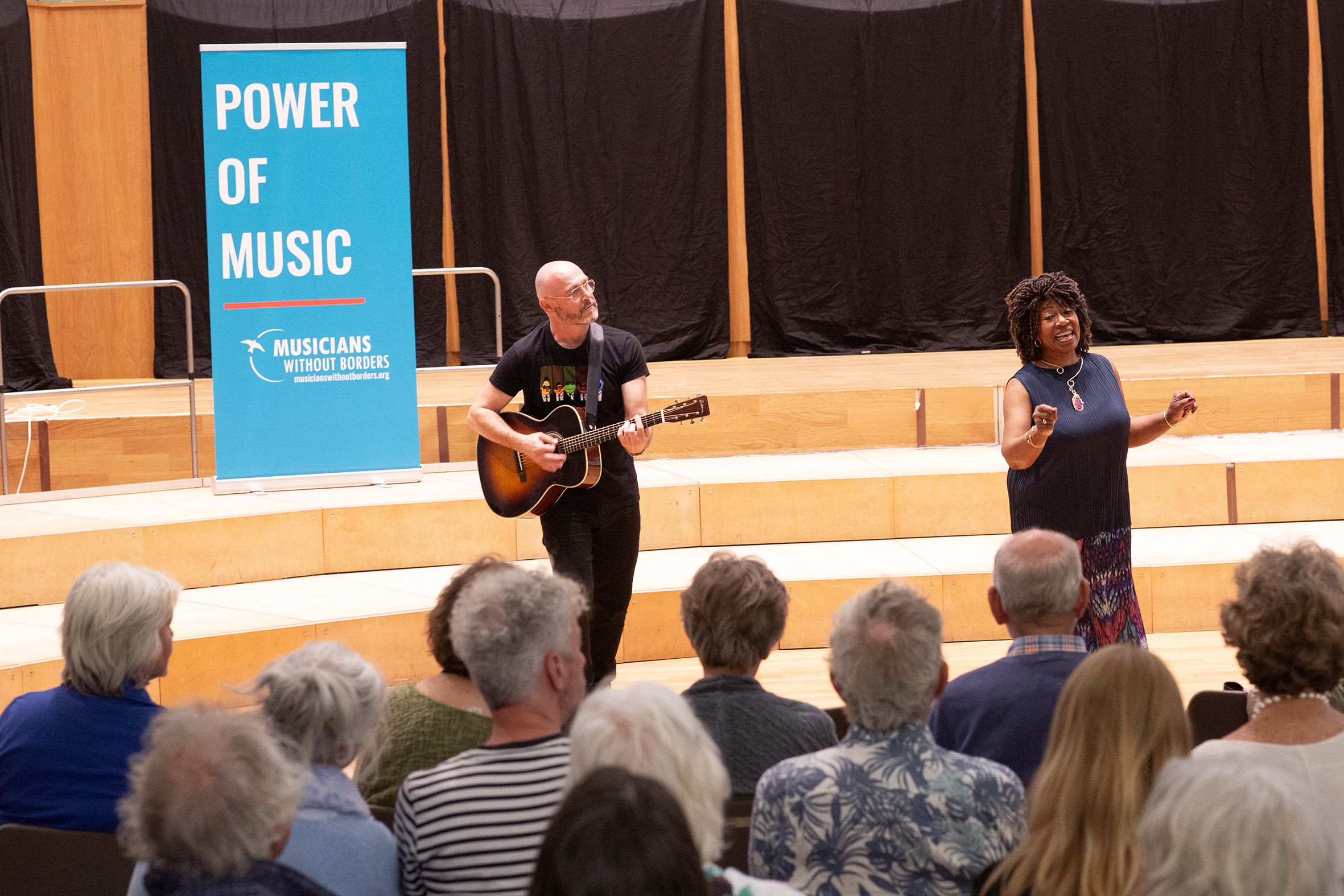
Two weeks ago, we came together, those of us now working for Musicians Without Borders , board members past and present, former staff, musicians who had sung and played in those very first projects in the Balkans, musicians who use their platforms today to promote our work, generous donors who have supported us across the years, partner organizations, regular folks who are part of our network—mostly from the Netherlands, although a few travelled—from Germany, Kosovo, the US, UK, Belgium, Italy—to join.

Also on behalf of all of you around the world—donors, subscribers, partners, friends—we met to mark this year, with stories, conversations, poems, music.
Remy van Kesteren played a beautiful harp improvisation and composition. Adriana Oliviera played her baritone sax. Vrouwvolk—my own vocal ensemble from so many years ago—regrouped to sing a few of the folk songs that started us on our way to the Balkans, so many years ago. Chris Colleye and Sherwin Kirindongo created a percussion composition, pulling us all into their joyful, magical energy. The amazing Denise Jannah surprised us with an improvised acoustic set at the very end.
And here are the poems and texts, read by Emily Beynon, with which we tried to capture the anguish of our suffering world—‘If I Must Die’ by Palestinian professor and poet, Refaat Alareer;
If I must die
If I must die,
you must live
to tell my story
to sell my things
to buy a piece of cloth
and some strings,
(make it white with a long tail)
so that a child, somewhere in Gaza
while looking heaven in the eye
awaiting his dad who left in a blaze—
and bid no one farewell
not even to his flesh
not even to himself—
sees the kite, my kite you made,
flying up above
and thinks for a moment an angel is there
bringing back love
If I must die
let it bring hope
let it be a tale.
The helplessness that so many of us feel in this moment—‘Rumi’ by Joseph Fasano;
Rumi
In a dream I asked him
What can I do
if I can’t change it?
And he pointed
To the graves
And whispered: witness it.Joseph Fasano
and some advice for those of us who continue to believe, who continue to continue…. words written by Arundhati Roy, currently under threat in India for her outspoken defense of human rights.
“The only dream worth having is to dream that you will live while you are alive, and die only when you are dead. To love, to be loved. To never forget your own insignificance. To never get used to the unspeakable violence and vulgar disparity of the life around you. To seek joy in the saddest places. To pursue beauty to its lair. To never simplify what is complicated or complicate what is simple. To respect strength, never power. Above all to watch. To try and understand. To never look away. And never, never to forget.”
Please read them. Please continue.
Thank you for your support.

Laura Hassler
Photos: Charlotte Brand