

Music Leadership Training
We developed our methodology for music leadership through more than 25 years of experience making music with people affected by conflict. It is an adaptive methodology, responding to needs and culture.
The approach has been used in our programs in Palestine, Rwanda, El Salvador, Jordan, Tanzania, Uganda, the Democratic Republic of Congo, Northern Ireland, and with refugees across Europe.
We have a full training curriculum to share our approach in programs and in courses with musicians, activists, and community leaders.
Musicians Without Borders has developed a methodology for music leadership through 25 years of experience making music with people affected by conflict – in Palestine, Rwanda, El Salvador, Jordan, Bosnia and Herzegovina, Tanzania, Uganda, the Democratic Republic of Congo, Northern Ireland, and with refugees across Europe.
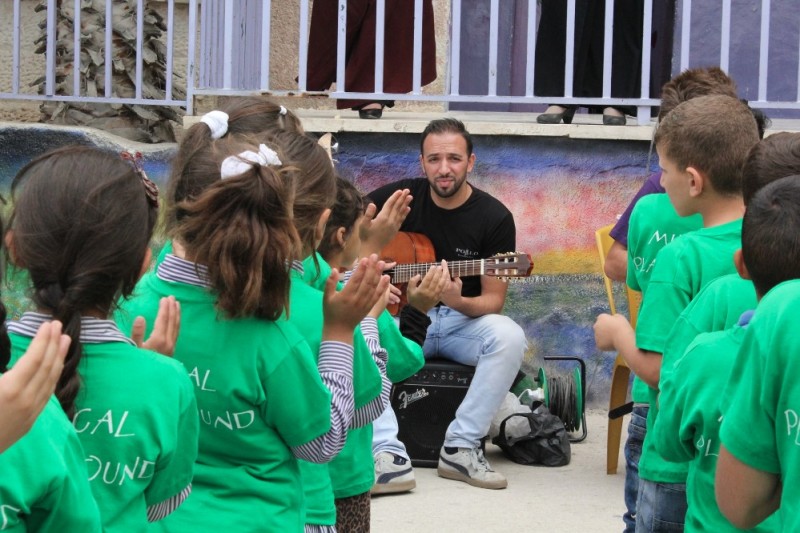
The methodology invites creativity and participation in places where children and communities live in fear, distrust, and isolation. Music leaders work with care and skill to offer relief, connection, and provide a much-needed safe space. Music leaders apply their skills to lead activities like singing, songwriting, movement and dance, rhythm, and games to engage with communities affected by violence, displacement, and conflict.
The adaptive methodology has been described as a Community Music methodology, but we don’t use that terminology in all settings. It is vital that musical interventions respond to needs and culture, and we work with partners in all our programs to understand how music can help to support the local community.
Together, we develop customised approaches, built upon three pillars.


1. Practical working principles
Five principles guide our music leadership methodology:
- Safety,
- Inclusion,
- Equality,
- Creativity,
- Quality.
2. Principles of nonviolence, fundamentals of universal human rights
Music has the power to connect, but in the wrong hands, can also be used to connect one group against another. This makes a nonviolent approach to our work essential. A clear set of values behind our practical work serves as a guide for our music leaders.
3. The biological, social and psychological effect of music
Our methodology is informed by an understanding of the ways that music can influence us biologically, socially and psychologically. We connect music to the nervous system, and the ways in which it can counter feelings of dysregulation caused by trauma, disconnection and extreme experiences.
Impact
Musicians Without Borders has been working with people and communities affected by war, conflict and displacement for 25 years. We’ve seen firsthand the effects of the music leadership methodology:
- In El Salvador, to combat gang culture and violence, we trained teachers in music leadership. The teachers used the methodology to incorporate musical and nonviolent approaches into their classrooms. Music becomes a model for peaceful coexistence.
- In Rwanda, children who face the stigma of living with HIV experience inclusion in music. Simple experiences of hearing their names sung, their rhythms echoed, and being welcomed by music leaders into bands create real change.
- Against the backdrop of violence and separation that characterize Europe’s refugee camps, moments of music-making initiated by trained leaders allow young people to reconnect and feel like themselves again.
Community Music and Music Leadership
Our methodology for music leadership overlaps with several schools of Community Music,. As the field continues to grow, our work draws interesting comparisons with models of practice from Community Music, and indeed we work with and learn from many community musicians within our network (some examples of this are shared here). However, our approaches are not aimed at falling within the scope of Community Music, and are most effective when they are driven by musicians and needs on the ground.
Working in countries and contexts where understandings of “music” are laden with linguistic and colonial legacies, and where constructed fields of knowledge are too often exported as fact, we prefer to free ourselves and our partners from the written histories and models of any field of practice. We draw from the great work of colleagues in every country where we work, valuing all knowledge and histories. We recognise that people and languages hold differing meanings, and this offers opportunity and beauty.
Since 2015, we offer open training courses in music leadership. Our training courses share the knowledge and skills of Musicians Without Borders ’ trainers with individuals from a variety of musical backgrounds.
While we design each training to specifically respond to the needs of our trainees, we always cover the main subjects of the methodology:
- Our five working principles – safety, inclusion, equality, creativity, quality – and how to apply them to group work,
- Leading musical activities in different cultural contexts,
- The ways that music influences us biologically, socially and psychologically, and how we can use music to improve personal and community wellbeing,
- How the principles of nonviolence can direct music activities towards social change.
To date, we have trained over 700 trainees from more than 55 countries. Past participants have gone on to apply our methodology in settings such as refugee camps and asylum centers, peace education workshops, local communities facing complex issues, juvenile detention centers, and community choirs.
Find all of our upcoming courses in our current course listing.
In addition to our regular courses, we also offer tailored training and workshops for organizations, businesses, conferences and universities. Training can be delivered online, in-person or in a hybrid format. For more information, please contact [email protected].
January 12, 2026 @ 10:00 AM – January 16, 2026 @ 6:00 PM (CET)
Leeds, UK
November 24, 2025 @ 11:00am - November 28, 2025 @ 1:30pm (CET)
Heek, Germany
Music leadership training with Leeds Beckett University
Musicians Without Borders in collaboration with Leeds School of Arts are bringing a new 5-day “ Welcome Notes ” training programme to Leeds. We are looking for facilitators and co-creators working across music and performing arts to participate in this unique training opportunity. The training course in Music Leadership will share the knowledge and skills of Musicians Without Borders ’ trainers with individuals from a variety of music and arts-based practices.
Community Music Training with Landesmusikakademie NRW
Musicians Without Borders , in collaboration with Landesmusikakademie NRW and the IN.DI.E Musik project, presents a new 5-day Community Music Training course in Heek, Germany. The training is aimed at musicians, educators, and facilitators who want to use music as a tool for social inclusion and connection. Participants will be introduced to Musicians Without Borders ’ trauma-informed methodology and gain practical skills in leading inclusive music activities.

Darren Abrahams

Fabienne van Eck

Rukengeza Espoir

Jose Pepe Garcia

Juan David Garzon

Marion Haak-Schulenburg

Otto de Jong

Manu van Kersbergen

Sherwin Kirindongo

Amanda Koser-Gillespie

Kana Yves Nzeyimana

Jim Pinchen

Ryuko Reid

Gregor Schulenburg

Marijke Smedema

Emma Smith

Guus van der Steen

Christa Tinari

Hanno Tomassen

Zaynab Wilson

Announcing the Music Leadership Summit 2021
Announcing the Music Leadership Summit 2021

Interview with Amanda Koser-Gillespie, trainer
Interview with Amanda Koser-Gillespie, trainer
Experiences from a Palestinian workshop leader
